
Burnham's cabinet picks represent a shift to social housing and a defeat for 'Labour YIMBY'
Plus - lobbyists paying journalists for copy and the frightening rise of e-bike fires

If you have the means to do so, please consider becoming a paid subscriber, which is billed monthly at just £3.50 or annually at £35. This provides access to subscriber-only posts and the back catalogue of more than 100 articles - as well as the opportunity to leave comments and submit questions for Q&A pieces.
If you pay £40 or more for an annual subscription, I will send you a signed copy of one of my books - Show Me The Bodies: How we let Grenfell Happen (which you can buy from an independent bookshop here) or Homesick: How housing broke London and how to fix it (which you can buy here). For £50, you get them both.*
Even if you can’t support financially, liking this article or forwarding the email to friends and colleagues really helps. All of my work is completely human-made - there is no use of AI in writing or editing. Thank you for reading!
As Andy Burnham’s new government took shape, there were some reasons to be cheerful from a social housing perspective. A couple of personnel changes mean there is a much stronger base of social housing support in the top levels of government than there has been for many decades.
First, in the housing department (MHCLG to give it a proper title), Angela Rayner returned. While Rayner hardly pulled up trees in her first stint as housing secretary, there were promising signs - particularly her heels-dug-in fight with the Treasury to win a substantial £39bn investment in social housing during the Spending Review, when earlier indications had suggested it would be a much smaller sum.
Pennycook, meanwhile, was a good pick as housing minister in the first place. As a backbench MP he’d been vocal on building safety and leasehold issues for some time before being elevated to the front bench. His choice of Rose Grayston (formerly of Generation Rent, the New Economics Foundation and Shelter) as expert advisor demonstrated that his approach to housing is broader than standard industry rhetoric. While she left the role in October 2025, there was no ideological split.
Pennycook has also been in the role for a long time now, having been shadow housing secretary since 2021. There is some real value in continuity in a role that has lacked it for a long time. He’s also been promoted: under Burnham, despite keeping the ministerial role, he will attend Cabinet - the first time a housing minister has done so.
I’m also pleased to see Florence Eshalomi join the department as minister for state. I liked her as chair of the Housing, Community and Local Government select committee, which has done some important work on issues such as children in temporary accommodation and Land Value Capture. Like Pennycook she brings the real world experience of being a backbench MP in a London borough where housing is likely to be many of her constituents’ number one priority.
Those who have followed housing policy over the years, though, will know that the real decisions are made in Number 10 and Number 11 - not the housing department.
This, too, should leave room for encouragement. John Healey, the surprise pick as chancellor, has a long interest in social housing. Healey attracted headlines because of his dramatic departure from his preceding role as defence secretary, but the bulk of his front bench career in Labour has been about social housing. He was housing minister in 2009 under Gordon Brown. In that role, he helped put together and deliver the country’s last big public investment in social housing and negotiated with the Treasury to give councils a self-financing deal over their housing stock, which will be the basis for any eventual renaissance of council house building.
Healey’s interest in social housing is genuine: in 2014, from the backbenches, he helped launch the ‘Social Housing Under Threat’ (SHOUT) campaign, which pushed forward an argument for social rented housing at a time when neither main political party was arguing for it. The campaign began partly in response to an article he penned in The Guardian titled ‘Social housing will perish if its supporters don’t defend it’.
In 2015, under Jeremy Corbyn, he was made shadow housing secretary, a role he held until he was reshuffled to shadow defence by Starmer in 2020 (with a brief interlude due to the failed Owen Smith leadership bid).
Throughout, he pushed an economic case for building 100,000 socially rented homes per year and helped orchestrate a long and bitter parliamentary fight against the Conservative government’s Housing and Planning Act. It was a fight (with help from Brexit and the resignation of David Cameron) that was ultimately won. When he left the role in 2020, he called on the sector to do more to argue the economic case for social rented housing at the top levels of government.
“The case for social housing is in rude health. It is not yet won within the heart of government… but it certainly can be,” he wrote.
Well, it is John himself who now needs to be persuaded. His record suggests that shouldn’t be too hard.
Burnham, too, has a form book which suggests his commitment to social housing goes beyond a soundbite. People may talk endlessly about the yellow buses, but his push for 10,000 new council homes in Greater Manchester was a serious, ambitious drive and was the primary policy objective of his third term as mayor.
There is a divide in the Labour Party on housing. The soft left are more interested in council housing, social rent and policy objectives like ending homelessness than they are a binary pursuit of increased supply. The centre right, meanwhile, will focus their efforts on overall supply targets, driven by private sector delivery and enabled by planning reform.
Replacing Starmer, Reeves and Steve ‘Build Baby Build’ Reed with Burnham, Healey and Rayner, is a defeat for the Labour YIMBY movement and a victory for the social housing wing.
Faith in politicians, of course, is easily misplaced. Rhetorical support for council housing is not the same thing as muscular fiscal backing.
The £39bn put on the table by Reeves was an impressive reversal of the austerity era funding programmes, but it needs to be larger, spent more rapidly and prioritised more heavily to social rent if it is to meet the scale of the ambition Burnham has set out. Other levers need to be yanked too - developable land needs to get into the hands of social housing providers. Our near-total reliance on the speculative development model needs to be shaken up. Ambitious affordable housing targets need to be baked into the system when new developable land is released.
In the end, Burnham must be judged on his actions, not his rhetoric or his increasingly-cringe inducing videos about how much he likes gigs and DJ-ing. As it stands, he’s a prime minister who looks set to approve major new North Sea drilling at a time when climate change-induced wildfires have brought Europe to standstill. That doesn’t scream of a man focused on radical change.
But there is a chance he might yet make a significant difference in terms of social housing supply. And the Cabinet he’s put together would appear to offer the best chance of that for many decades.
Lobbying and journalism
Some of you may have noticed my byline in The Guardian last week, which published the result of a long-running investigation into a lobbying firm secretly paying journalists for copy favourable to their clients.
The investigation began when I was approached by the firm, CT Group, to discuss the Building Safety Regulator. At the meeting, it emerged that they hoped to pay me for content I’d then pitch to national papers which emphasised the impact of housing shortages and linked it to delays caused by the BSR.
Ultimately, we were able to film the firm’s staff offering money for other property related stories and explaining that they had paid other journalists for content in the past.
All of which is deeply worrying. “Lobbyists paying journalists to produce apparently independent articles is an attack on the ethics of journalism, public relations and, indeed, on democracy,” said the Chartered Institute of Public Relations in response to the article.
I’m inclined to agree. The Building Safety Regulator was - as readers of this Substack will well know - a major change to the construction and management of high rise buildings in this country. It was a big extension of state power and it deserved scrutiny, especially as it started to go wrong.
It’s fine for people with some degree of vested interest to enter this debate. A vested interest makes you take an interest in the detail of a topic which others won’t. But for the conversation to function properly, you should be able to see what these interests are. Hiding that poisons the overall debate.
It also undermines trust.
No one knows how common the practice of secret payments to journalists is, and whether it extends beyond the lobbying firm at the heart of The Guardian investigation. But knowing now that it has happened is something which will pop into my head next time I read something which might be a completely honestly held opinion or might be something that benefits a particular interest group. Once you know one Tour de France winner has doped, all future holders of the yellow jersey are tainted. Any journalist involved in this practice is not just undermining their own integrity, but damaging the whole profession.
A new dumping ground
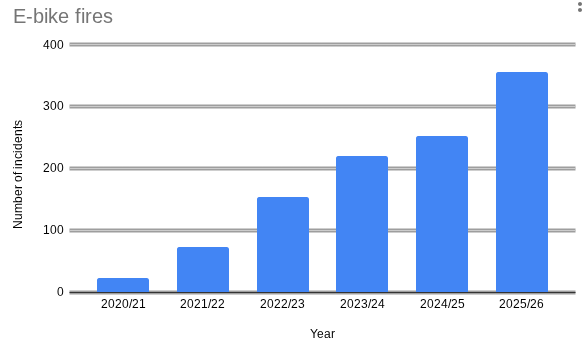
E-bike fires have been quietly transforming fire safety statistics - and claiming lives. Data I gathered for Inside Housing, published last week, puts it starkly.
Across all of the 23 fire authorities who responded to our FOIs, there were just 24 e-bike fires in 2020-21. By 2025-26, the number recorded by these same authorities had risen to 356 – almost one incident a day. That’s a 15-fold increase and it shows no sign of slowing down.
What is perhaps missed in this trend is that the issue is very much #NotAllBikes. According to researchers at the University of Warwick, who tested a range of bike batteries to destruction, if you buy a road-legal e-bike from a reputable store, you’re almost certainly getting a safe product. If you buy a high-powered conversion kit imported from China via an online retailer, then you are potentially one wrong-charger away from a thermal runaway fire.
This changes the problem, and the potential solutions. We don’t need to regulate the use of ebikes as much as get rid of the dangerous ones. This means regulating online marketplaces, which is where they are mostly bought. It also means limiting demand by providing better employment protections and conditions to the gig-economy workers who are the primary market. Germany, which is better than us on both fronts, has 20 times as many e-bikes and a fraction of the fires.
Unfortunately, policy has been pushing in the opposite direction in recent years. While the EU introduced specific anti-dumping measures in relation to Chinese e-bike imports, the UK elected not to - citing the economic gains from cheaper products.
“We have possibly become a bit of a dumping ground for poor-quality products,” one expert I spoke to said.
Those who followed the Grenfell story will remember that the same was once said of flammable cladding. Let’s hope this saga doesn’t end with a similar disaster.
In other news
The Metropolitan Police is considering both corporate and gross negligence manslaughter in its investigation into the death of a young man who fell from a balcony at a housing association block due to a railing giving way.
The London Plan will see a third of the capital’s boroughs return to a 35% affordable housing target from 2028. The 11 most inner London boroughs will see the threshold at which ‘fast-track’ planning is granted raised, while outer boroughs will be lifted to 25% and those on the fringes of the city will remain at 20%. The measures were supposed to be a temporary response to viability challenges impacting builders in the capital.
Some Scottish housing associations have had to close their offices due to far right protests, as misinformation about the allocation of social homes to recently-arrived immigrants continues to spread.
If you have the means to do so, please consider becoming a paid subscriber, which is billed monthly at just £3.50 or annually at £35. This provides access to subscriber-only posts and the back catalogue of more than 100 articles - as well as the opportunity to leave comments and submit questions for Q&A pieces. Students, tenants, campaigners, people on low incomes - hit reply and I’ll gift one for free.
If you pay £40 or more for an annual subscription, I will send you a signed copy of one of my books - Show Me The Bodies: How we let Grenfell Happen (which you can buy from an independent bookshop here) or Homesick: How housing broke London and how to fix it (which you can buy here). For £50, you get them both.*
If you are interested, I can be booked for paid speaking gigs and am experienced at doing board away days, senior leadership team training sessions and similar. Contact monica@aitkenalexander.co.uk to discuss.
Even if you can’t support financially, liking this article or forwarding the email to friends and colleagues really helps. All of my work is completely human-made - there is no use of AI in writing or editing. Thank you for reading!
*Signing up as a founding paid subscriber will generate an email to me, which I will respond to by asking you which book you’d like and a postal address. It may take a few days to get it to you, because I don’t always have available stock. Be aware that if you sign up for an annual subscription at a higher rate this renews annually at the rate you selected. So if you intended a one off donation (for which I’m grateful), remember to cancel and resubscribe at the regular rate before it renews