
The Construction Products Reform White Paper does not do enough to tackle the dark heart of the cladding scandal
Leaving testing and certification in the private sector invites another scandal and misses the point of the Grenfell Tower Inquiry's recommendation. Plus - PAS 9980 and record homelessness

All of my work is completely human-made - there is no use of AI in research, writing or editing. If you have the means to do so, please consider becoming a paid subscriber, which is billed monthly at just £3.50 or annually at £35. This provides access to subscriber-only posts and the back catalogue of more than 100 articles - as well as the opportunity to leave comments and submit questions for Q&A pieces.
If you pay £40 or more for an annual subscription, I will send you a signed copy of one of my books - Show Me The Bodies: How we let Grenfell Happen (which you can buy from an independent bookshop here) or Homesick: How housing broke London and how to fix it (which you can buy here). For £50, you get them both.*
Even if you can’t support financially, liking this article really helps boost it up the Substack algorithm, and forwarding the email to friends and colleagues who might be interested helps boost engagement. Thank you for reading!
You could argue that the Grenfell Tower fire happened at the confluence of five systemic failures.
First, the construction sector and its cost cutting, shoddy workmanship and lack of accountability.
Second, social housing and the drift over many decades away from good, basic maintenance.
Third, central government, and its obsession with deregulation, which made it incapable of imposing tougher rules even in the face of clear warnings.
Fourth, the fire service - and the institutional drift which left it fatally reliant on ‘stay put’ strategies to deal with fire risks in high rises.
Fifth, dishonest practice among construction products manufacturers, who buried test data, placed sales above safety and captured and manipulated the regime of testing and certification which was supposed to hold them to account.
For several reasons, this fifth area stands out.
First because it sits right at the centre of what happened. The primary reason for the fire spreading so fast at Grenfell was the presence of cladding with a level of combustibility similar to petrol on its walls.
This is what created the situation where the broken fire doors and lack of evacuation strategies became deadly. It is the presence of dangerous products on the market that made the culture in construction of buying the cheapest material so dangerous.
The behaviour involved in this aspect of the story was also by some considerable distance the most cynical and mendacious. A lot of the other actors were simply closing their eyes to risks, incompetent or indifferent. It was the product manufacturers who knew the danger and chose profits anyway.
They were also the most powerful. These were not the mistakes of a cash-strapped town hall, a contractor scrapping for a 2% profit margin or an overworked and undervalued team of civil servants, but companies who measure their turnover in billions and whose products form part of supply chains which criss-cross the globe.
It may come as a surprise to hear, then, that nine years on from the fire it is the only one of the five areas I outlined at the top which has seen next to no meaningful reform.
The construction sector now has a Building Safety Regulator watching over the way it builds and refurbishes tower blocks. The social housing sector has a series of new legislative requirements and a new regime of regulation covering its provision of services to tenants. The London Fire Brigade has been through a major overhaul and now has much better strategies to get residents out of burning tower blocks alive. And even central government has - grudgingly - passed much tougher fire safety rules and committed itself to further change.
I could (and have) criticise all of these steps. But at least there is something tangible to point at that is different from before.
But in the testing, manufacture and certification of construction products, things continue much as they did before Grenfell. The government’s own analysis of its actions so far (a limited boost to the powers of the Office for Product Safety and Standards) is that they “have not been sufficient to address the critical gaps in the regime”.
This is the gap that yesterday’s Construction Products White Paper was supposed to fix. Sadly, it falls short.
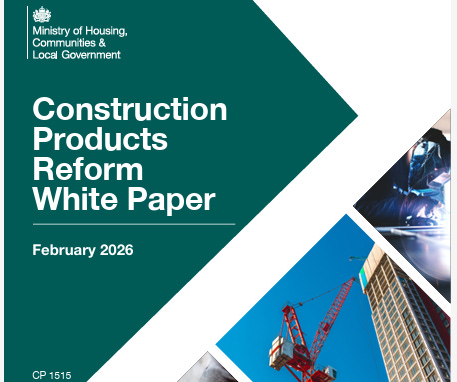
The White Paper proposes a series of quite technical reforms. Overall it is really trying to make the existing regime more robust and fill in the gaps, rather than overhaul it entirely - which is what the scandal really demands.
At the moment, some products are covered by ‘designated standards’ derived from EU law. These are technical standards which set the performance requirements for various different construction products. They will have a long code made of letters and numbers and will be totally incomprehensible to anyone who isn’t in the industry. For example, EN-14531 covers doors and windows and sets requirements for wind load resistance, water tightness and so on.
The trouble in this area is that a) (in the government’s own words) these standards are about achieving smooth trade within the EU not necessarily safety and b) a lot of the market isn’t actually covered by them. The White Paper’s central estimate is that about 37% of the market has a relevant standard. The rest doesn’t, so doesn’t really have clear standards it needs to meet to be on the market, and there is nothing to regulate it against.
The White Paper proposes fixing this by introducing a General Safety Requirement (GSR) for products not covered by a specific standard, which will require manufacturers to assess the safety from reasonable uses of the product.
Which is a nice sensible reform. Although it won’t apply to the products already covered by a designated standard where - despite acknowledging that safety isn’t always the focus - the White Paper says to “support supply chains and growth” we will reain consistency with the EU. Why not apply the GSR to everything, in addition to the designated standards, fixing in a stroke any gaps in the existing regime?
A bigger problem is that this is a technical change to the market that has emerged from post-Grenfell reviews, but it is not in any sense an answer to the problems the Grenfell Tower Inquiry uncovered.
The problem there was not the scope of designated standards and the absence of general safety provisions - something the evidence barely touch on and the inquiry report’s recommendations do not mention.
Instead, what the inquiry uncovered was a culture among product manufacturers of hiding test data, manipulating testing to their advantage and using a pliant certification regime to boost inaccurate claims about the safety and performance of their products.
The white paper attempts to fix this by setting out further powers to regulate the activity of private bodies offering testing and certification services to product manufacturers. The single construction regulator, when it is finally active, will be empowered to oversee the work of these firms. There will be greater transparency requirements placed on manufacturers to release negative test data they would rather have kept quiet. But that is as far as we will go. The same private system with the same private actors will remain, it will just be policed by a different body with greater powers, and transparency will rely on manufacturers willingly complying with the law.
But this leaves the problems of the current regime in place. As the white paper itself acknowledges, having private firms selling testing and certification services to manufacturers creates an inherent “conflict of interests resulting in [testing and certification bodies] putting commercial incentives over the public interest”.
Basically, if these firms are reliant on the manufacturers to provide their income, they form commercial relationships with them and it becomes very hard to stand up and say ‘no, you can’t have that certificate for that product’ - particularly in a commercial environment when a competitor may be more willing to look the other way. The result was the regulatory capture the inquiry evidence detailed in such a painstaking way.
The solution the inquiry had told the government to take was more radical. They said the single construction regulator should directly take on the function of testing products and issuing certificates. It wanted these certificates, issued by the regulator, to “become pre-eminent in the market”. Effectively, it was calling for the renationalisation of testing and certification (which went into private hands in the 1980s and 1990s).
This is not too radical an ask. It just returns us to the 20th century norm and puts us on a par with other countries like which France still has a nationalised building science facility,. Their economy and house building operation has not collapsed into ruin as a result.
In a classic piece of PR-led sophistry the White Paper, doesn’t even say that the government is rejecting this (to my mind) core inquiry recommendation. Instead it says it is “accepting the Inquiry’s recommendation in principle”, when it is actually chucking it out and taking a different, less radical approach. This isn’t really ok, and is exactly why a lot of people (including me) think we need some sort of National Oversight Mechanism to provide some independent scrutiny of government responses to this sort of thing.
Another point of disappointment is the absence of any solid proposal for requiring product manufacturers to contribute to cleaning up the mess their products have made. The white paper contains a broad commitment to “streamline the process to hold manufacturers accountable where defective cladding products have made buildings unfit for habitation historically”.
And while this isn’t a bad thing, it is a good deal less tough than the deal offered to housebuilders (pay up or we will legally stop you from building anymore homes), social landlords (pay via your balance sheet and do your best to recoup from your supply chain) and leaseholders (you’re protected from some costs but in other cases you are simply screwed as a result of buying a flat and the law can’t protect you, sorry). Really, a house builder-style ultimatum should have been thrown on the table: contribute or we’re banning your product from the UK market. That’s what Michael Gove was threatening back in 2023. This is weak sauce by comparison.
While promises to “make a breach of regulations a criminal offence that is punishable by an unlimited fine, imprisonment, or both” sounds strong, when you stop and think about it - isn’t it more surprising that this requires change at all? Having no criminal penalty for breaking the rules in a way that endangers life safety is a surprising position to have found ourselves in. Addressing that is good, but it does feel a little like the bare minimum.
Overall though, this White Paper stops short of the transformative change this area of the story demands. While we are unlikely to see the sale of Grenfell-style cladding return, many building safety scandals down the years have poor products or poor systems at their heart, with improper testing, a lack of transparency and the greed of companies who would profit from the sales driving the scandal (see LPS and timber frame, inter alia).
Remediating dangerous buildings is hard. Ensuring buildings are built and maintained safely is hard. Keeping dangerous products off the market in the first place should be easy by comparison, if we had the guts to impose a truly independent and robust regime of regulation. The sale of dangerous products, and the manipulation of testing and regulatory capture which sat behind it, is the dark heart of the whole cladding scandal. These reforms leave it beating.
PAS 9980 - the problem of uncertainty
I’ve been working on a long read about government guidance on dangerous cladding for Inside Housing over the last month, and it published this week here.
Having done several long interviews to support the piece, my view has not changed greatly since January when I last covered it for this Substack.
I still think that it is true that we cannot remediate every building with combustible materials in their walls, and nor would it be wise to try. For some buildings you would be causing enormous disruption and spending extraordinary amounts of money and industry capacity for little if any gain in terms of safety.
We do need some means to distinguish very dangerous buildings, from the moderately dangerous, from the safe. Whatever form that takes, it is never going to be perfect and is never going to please all of the various interested parties involved. There is nothing wrong with trying to do this
However, the critics of PAS 9980 are correct about its fundamental flaw. Opting, as it does, to leave the decision almost wholly within the “subjective” view of individual fire engineers creates an environment where abuse, incompetence or the simple reality of commercial pressures are bound to create bad outcomes. It also creates desperate uncertainty about which buildings will be remediated and to what extent, which is bad for leaseholders and bad for business.
Not having insurers on the steering group for the new draft of the standard feels like a major error. The Association of British Insurers is already speaking out against it, and warning premiums may remain elevated even after buildings are fixed under its terms. You can argue about who is right and wrong here (and insurers should, in my view, be willing to offer more reasonable premiums in many buildings), but the challenge for policy makers was to find a middle ground where remediation also resulted in affordable insurance. It doesn’t look like they’re going to achieve it.
There are also very obvious risks. I think too much expanded polystyrene is being left on buildings and deemed tolerable, given its fuel content and capacity for rapid multi-directional fire spread. I don’t think the risk from timber balconies is being properly recognised, given the real world fires and worrying official testing.
Not enough account is being taken of the potential presence of disabled residents or additional fire safety defects that may change the picture in terms of safety. Lakanal House, were it investigated today, may well avoid remediation on the basis of limited amounts of combustible materials on its walls - but the presence of other building safety defects meant this risk was in fact very far from tolerable.
Make no mistake, we are gambling here. It may not happen (and hopefully never will) but if there are multiple fatalities after a facade fire in a block which was deemed tolerable under PAS 9980, the reckoning for those involved will be brutal.
As an aside, it is worth looking to Australia for how it could be done differently. They also have guidance on assessing ‘tolerable’ risks from facade systems. I have neither the technical or practical knowledge to pronounce on whether or not the Australian guidance is perfect (and the reality of this issue means there will be some trade offs), but what it certainly does offer is more prescription and more certainty. Tolerable facade types are described in detail, with the reasoning explained. This will likely lead to far less uncertainty and faster decisions on remediation. That feels like something which should be in everyone’s interest.
Homelessness - another record breaking quarter for Labour
When Labour took office, one of the key metrics on which I said I would judge their housing policy was how effective they were at reducing the number of children in temporary accommodation.
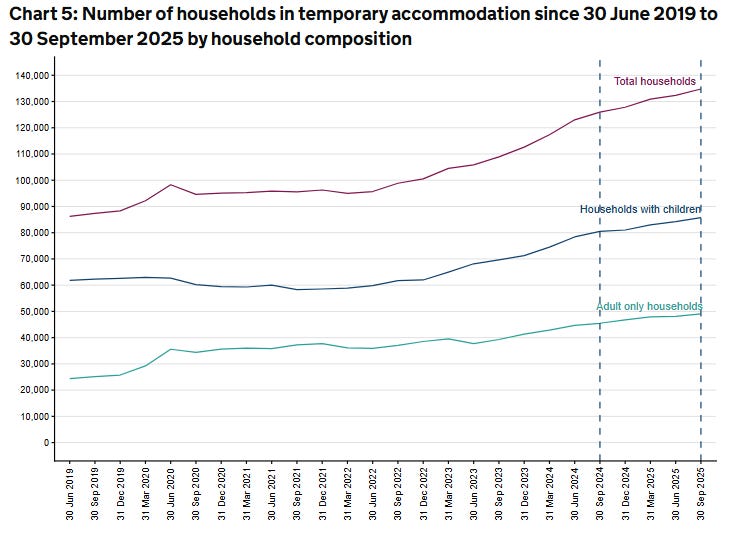
Well, no need to trouble the scorers on that one. The latest figures, out today, show that Labour is setting unwanted records for both rough sleeping and the number of homeless households in temporary accommodation. There were an estimated 4,763 people sleeping rough on a single night as of Autumn 2025, a 3% rise from 2024, and exceeding the previous peak of 4,751 seen in 2017. We’ve also seen the very worrying rise of children rough sleeping, which simply shouldn’t happen and is a very clear symptom of a system that has stopped functioning.
The number of households living in temporary accommodation has also hit a further reach record levels, at 134,760 in September- breaking the record set last time the figures came out. Labour has set a new record every quarter in this regard.
Of these, 85,730 households in temporary accommodation included dependent children, with 175,990 children living in temporary accommodation in total. All of these are very grim records with very serious consequences for child development, health, education and local authority finance.
There are, of course, long-term drivers of this chaos which were never going to be solved overnight, but what is worrying is that it is an issue Labour does not seem to care about or have any semblance of a real plan for. Steve Reed, the housing secretary, has promised to end “the moral stain of homelessness” by building more homes for the private market, with the very vague hope that over a period of decades this will improve the homelessness numbers via the ‘vacancy chain’ effect (someone moves out of a cheaper house into a new build, creating a vacancy and so on).
Last week Shelter published research criticising this “trickle down” housing policy.
“One optimistic study from Germany found that a 1% increase in new housing supply lowers average rents by 0.19%. Another study in New York found that, within a 500ft area, rents decrease by 1% after a 10% increase in the housing stock. ‘Concealed’ and homeless households aren’t just trying to find a slightly better property in the market to move into. They’re unable to enter the market to begin with,” it said.
There are 175,990 children who need the government to become a lot bolder.
All of my work is completely human-made - there is no use of AI in research, writing or editing. If you have the means to do so, please consider becoming a paid subscriber, which is billed monthly at just £3.50 or annually at £35. This provides access to subscriber-only posts and the back catalogue of more than 100 articles - as well as the opportunity to leave comments and submit questions for Q&A pieces.
If you pay £40 or more for an annual subscription, I will send you a signed copy of one of my books - Show Me The Bodies: How we let Grenfell Happen (which you can buy from an independent bookshop here) or Homesick: How housing broke London and how to fix it (which you can buy here). For £50, you get them both.*
Even if you can’t support financially, liking this article really helps boost it up the Substack algorithm, and forwarding the email to friends and colleagues who might be interested helps boost engagement. Thank you for reading!